Artículo Mikhail Khomenko · dic 23, 2019 12m read

Last time we deployed a simple IRIS application to the Google Cloud. Now we’re going to deploy the same project to Amazon Web Services using its Elastic Kubernetes Service (EKS).

We assume you’ve already forked the IRIS project to your own private repository. It’s called <username>/my-objectscript-rest-docker-template in this article. <root_repo_dir> is its root directory.

Before getting started, install the AWS command-line interface and, for Kubernetes cluster creation, eksctl, a simple CLI utility. For AWS you can try to use aws2, but you’ll need to set aws2 usage in kube config file as described here.

1
3 1669
Artículo Mikhail Khomenko · ene 13, 2020 16m read

Last time we launched an IRIS application in the Google Cloud using its GKE service.

And, although creating a cluster manually (or through gcloud) is easy, the modern Infrastructure-as-Code (IaC) approach advises that the description of the Kubernetes cluster should be stored in the repository as code as well. How to write this code is determined by the tool that’s used for IaC.

In the case of Google Cloud, there are several options, among them Deployment Manager and Terraform. Opinions are divided as to which is better: if you want to learn more, read this Reddit thread Opinions on Terraform vs. Deployment Manager? and the Medium article Comparing GCP Deployment Manager and Terraform

1
2 1566
Artículo Timothy Leavitt · ene 15, 2020 9m read

Introduction and Motivation

A unit of ObjectScript code (a ClassMethod, say) may produce a variety of unexpected side effects by interacting with parts of the system outside of its own scope and not properly cleaning up. As a non-exhaustive list, these include:

  • Transactions
  • Locks
  • I/O devices
  • SQL cursors
  • System flags and settings
  • $Namespace
  • Temporary files

Use of these important language features without proper cleanup and defensive coding can lead to an application that normally works correctly, but that may fail in unexpected and difficult-to-debug ways.

8
6 1677
Artículo Timothy Leavitt · mar 24, 2020 5m read

This article will describe processes for running unit tests via the InterSystems Package Manager (aka IPM - see https://openexchange.intersystems.com/package/InterSystems-Package-Manager-1), including test coverage measurement (via https://openexchange.intersystems.com/package/Test-Coverage-Tool).

Unit testing in ObjectScript

There's already great documentation about writing unit tests in ObjectScript, so I won't repeat any of that. You can find the Unit Test tutorial here: https://docs.intersystems.com/irislatest/csp/docbook/Doc.View.cls?

23
2 2172
Artículo Mikhail Khomenko · feb 11, 2020 17m read

In an earlier article (hope, you’ve read it), we took a look at the CircleCI deployment system, which integrates perfectly with GitHub. Why then would we want to look any further? Well, GitHub has its own CI/CD platform called GitHub Actions, which is worth exploring. With GitHub Actions, you don’t need to rely on some external, albeit cool, service.

In this article we’re going to try using GitHub Actions to deploy the server part of  InterSystems Package Manager, ZPM-registry, on Google Kubernetes Engine (GKE).

1
1 1094
Artículo Nikolay Solovyev · feb 17, 2020 5m read

Dasha.AI is a platform that allows you to create and manage voice interfaces for your applications. One of Dasha’s distinctive features is that most users believe they are talking to a human, not a robot.

Voice is the most natural way for people to interact. Dasha allows to use voice interface to interact with your application as naturally as communication between people.   

The voice interface cannot completely replace the traditional user interface of the application, but some tasks could be perfectly solved with the help of the speech interface.

0
3 380
Artículo Evgeny Shvarov · feb 24, 2020 9m read

Hi Developers!

Many of you publish your InterSystems ObjectScript libraries on Open Exchange and Github.

But what do you do to ease the usage and collaboration to your project for developers?

In this article, I want to introduce the way how to introduce an easy way to launch and contribute to any ObjectScript project just by copying a standard set of files to your repository.

Let's go!

21
6 2512
Artículo Evgeny Shvarov · mar 20, 2020 3m read

Hi colleagues!

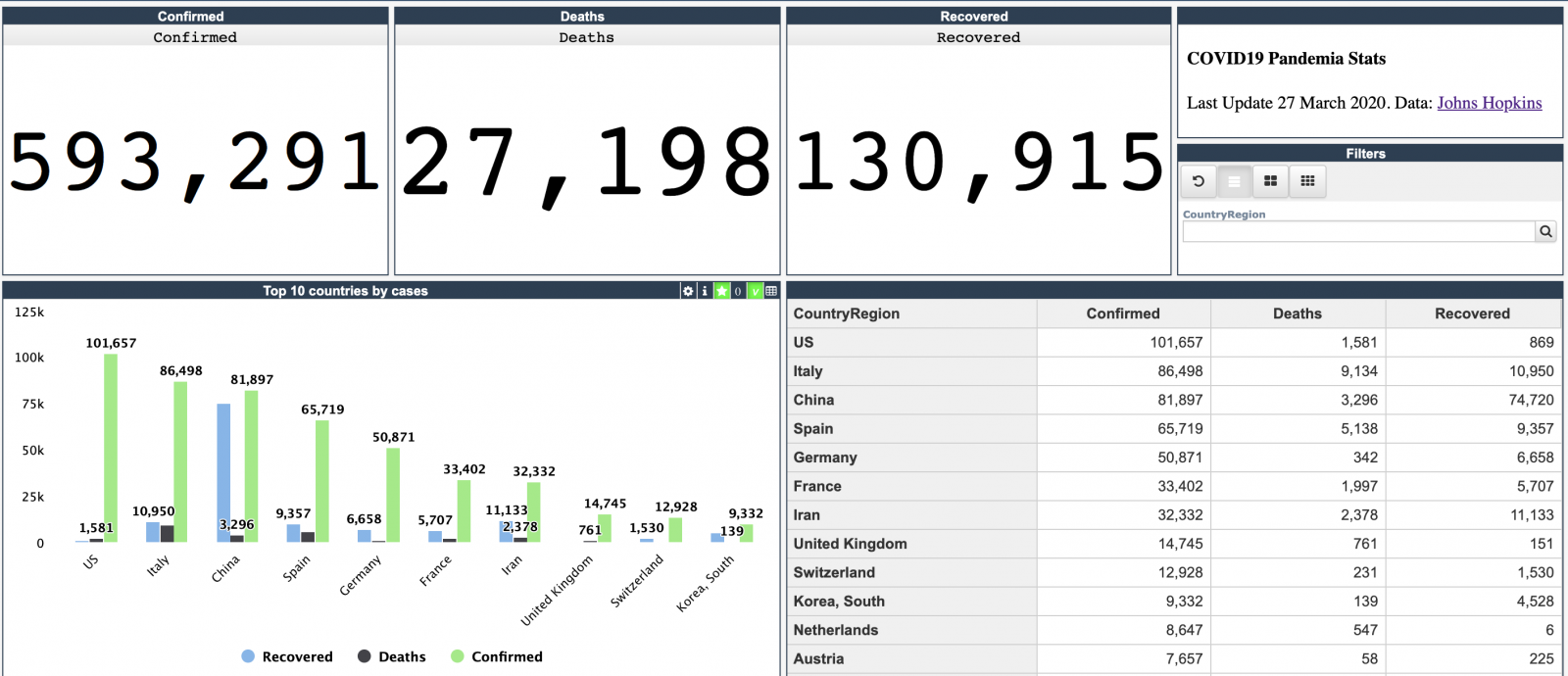
Every day Johns Hopkins University publishes new data on coronavirus COVID-19 pandemic status.

I built a simple InterSystems IRIS Analytics dashboard using InterSystems IRIS Community Edition in docker deployed on GCP Kubernetes which shows key measures of the disease outbreak.

This dashboard is an example of how information from CSV could be analyzed with IRIS Analytics and deployed to GCP Kubernetes in a form of InterSystems IRIS Community Edition.

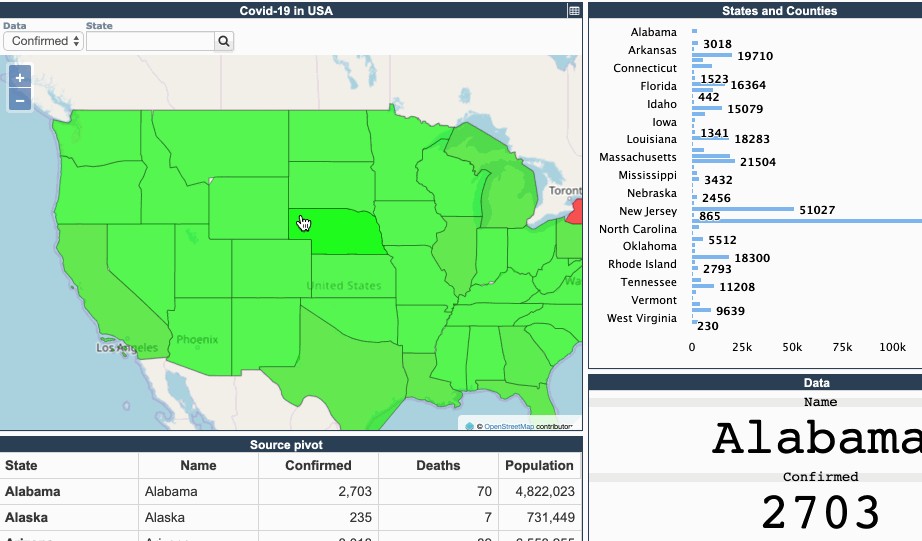
Added the interactive map of the USA:

13
3 1126
Anuncio Henry Pereira · mar 27, 2020

SQLBuilder is a flexible and powerful SQL query string builder for InterSystems IRIS,

With SQLBuilder you have nice and clean object oriented methods, instead of having to use concatenation and substituition to generate dynamic queries.

A Dynamic SQL without SQLBuilder

A Dynamic SQL with SQLBuilder


If you like it, don't forget to vote in the IRIS Programming Contest

18
5 817
Artículo Jose-Tomas Salvador · abr 8, 2020 6m read

This time I want to talk about something not specific to InterSystems IRIS, but that I think is important if you want to work with Docker and your server at work is a PC or laptop with Windows 10 Pro or Enterprise.

As you likely know, containers technology comes basically from Linux world and, nowadays, is on Linux hosts were it shows maximum potential. Those who use Windows on a normal basis see that both, Microsoft and Docker, have done important efforts during these last years that allow us to run containers based on Linux images on our Windows system in a really easy way... but it's something not supported for production systems and, this is the big problem, is not reliable if we want to keep persistent data outside of containers, in the host system,... mostly due to the big differences between Windows and Linux file systems. In the end, Docker for Windows itself uses a small linux virtual machine (MobiLinux) to run the containers... it does it transparently for the windows user... and it works perfectly well if, as I said, you don't require that your databases survive longer than the container...

Well,...let's get to the point,... the point is that many times, to avoid issues and simplify, we need a full Linux system and, if our server is based on Windows, the only way of having it is through a virtual machine. At least till WSL2 in Windows is released, but that will be another story and sure it'll take a bit of time to become robust enough.

In this article, I'll tell you, step by step, how to install an environment where you'll be able to work, if you need it, with Docker containers on an Ubuntu system in your Windows server. Let's go...

11
3 29886
Artículo Tani Frankel · mayo 6, 2020 2m read

While reviewing our documentation for our ^pButtons (in IRIS renamed as ^SystemPerformance) performance monitoring utility, a customer told me: "I understand all of this, but I wish it could be simpler… easier to define profiles, manage them etc.".

After this session I thought it would be a nice exercise to try and provide some easier human interface for this.

The first step in this was to wrap a class-based API to the existing pButtons routine.

I was also able to add some more "features" like showing what profiles are currently running, their time remaining to run, previously running processes and more.

The next step was to add on top of this API, a REST API class.

With this artifact (a pButtons REST API) in hand, one can go ahead and build a modern UI on top of that.

For example -

15
4 1363
Anuncio Guillaume Rongier · abr 6, 2020


InterSystems offers an API-design first approach.

You can check this post for more informations : https://community.intersystems.com/post/iris-api-explorer-application.


One practical thing about this approch and the OpenAPI specification is the definition of exchange objects.

The do ^%REST command does not create object definitions, but only routes and associated methods.


Output for the do ^%REST command for PetShop example :

USER>do ^%REST

REST Command Line Interface (CLI) helps you CREATE or DELETE a REST application.

2
5 1053
InterSystems Official Raj Singh · abr 12, 2020

I’m excited to announce that InterSystems will be joining the open source community for InterSystems ObjectScript extension to Visual Studio Code. Early this year I posted that we were on a journey to redefine the future of our IDE strategy, and what came out of that is Visual Studio Code is the IDE that can support that future.

3
6 1889
Artículo Zhong Li · abr 16, 2020 12m read

Keywords: COVID-19, Medical Imaging, Deep Learning, PACS Viewer, and HealthShare.


Purpose

We are all gripped by this unprecedented Covid-19 pandemic. While supporting our customers in battlefields by any means, we also observed various fighting fronts against Covid-19 by leveraging today's AI powers. 

Last year I briefly touched a deep learning demo environment.

3
1 1913
Artículo Mikhail Khomenko · abr 20, 2020 14m read

This article is a continuation of Deploying InterSystems IRIS solution on GKE Using GitHub Actions, in which, with the help of GitHub Actions pipeline, our zpm-registry was deployed in a Google Kubernetes cluster created by Terraform. In order not to repeat, we’ll take as a starting point that:

1
1 761
Artículo Robert Cemper · abr 25, 2020 2m read

The typical WHERE condition in SQL relates mostly to some content of the rows you work on.
So it needs to be calculated and checked for each row you access.
Differently (and that's why I named it STATIC) is a WHERE condition that is independent of the rows you access.

2
1 609